Agricultural autonomy: giving farmers back their time

On the occasion of an interview with Agridées, Christophe Aubé, President and Founder of Agreenculture, shares his vision of autonomous agriculture and discusses the challenges involved in the development of agricultural autonomy by answering three key questions. "The son of a farmer, Christophe Aubé is the founding president of Agreenculture , a company based in Toulouse and created in 2016 that develops autonomous agricultural solutions.
Beyond the lack of manpower, why does the agriculture of tomorrow need automation and what is the promise of Agreenculture?
French and European agriculture faces a particularly complex equation: a continuous decrease in the number of farmers, economic pressure on farms, the need to maintain food sovereignty and the acceleration of the agroecological transition.
Furthermore, agricultural practices are shifting towards precision agriculture, which is more sustainable and respectful of the soil. In all cases, whether it involves mechanical weeding, localized interventions, or certain soil conservation strategies, these practices require more labor and more technical monitoring, mobilizing more data to guide decision-making.
How can we enable farmers to engage in these transformations while requiring less human labor? This is precisely where autonomy becomes meaningful, freeing up their time.
We often talk about self-guidance, but it primarily provides comfort. Autonomy, on the other hand, saves time. An autonomous machine can perform a task while the farmer focuses on other, higher-value activities.
I am also convinced that the future lies in simpler, lighter, smarter, and more electrified machines. Farms will need solutions capable of reconciling economic profitability, environmental sustainability, and operational performance. At the European level, if we want to maintain our production capacity while meeting new agronomic challenges, the large-scale deployment of autonomous solutions will become essential.
Despite advances in agricultural robotics and agricultural autonomy, adoption rates remain limited in crop production. What conditions are necessary for true scaling up?
To access a mass market, the primary criterion is demonstrating profitability. Farmers naturally think in terms of total cost of ownership (purchase, operation, maintenance, return on investment timeframe, etc.). This is an extremely pragmatic and perfectly legitimate approach, valid for farmers worldwide.
The second element is confidence in the solution. In recent years, several AgTech players have experienced significant difficulties or disappeared, particularly in robotics. Each failure weakens the entire ecosystem. When a farmer invests in equipment, they need to be certain that it will still be working in ten years and that they will still have access to after-sales service and spare parts. Today, they are increasingly turning to major agricultural equipment brands for greater security.
Finally, the last criterion is sustainability: we are moving towards machines that are reliable in the long term, simpler and lighter, allowing for more reasoned approaches, with smarter use of inputs, and that help preserve biodiversity. This is the case with strip cropping, for example. Unfortunately, all of this remains difficult for farmers to promote.
Agreenculture has become a manufacturer of robotics kits for agricultural equipment suppliers. What is the current state of your company's development, and what tasks are best suited to robotics?
To truly transform the market, we believe in integrating robotics into existing networks of manufacturers and dealers. These players already have a relationship of trust with farmers.
Our strategy is to accept a certain stability in our product offering, allowing these traditional production and distribution networks time to become familiar with our solutions: this is how we can reach a mass market.
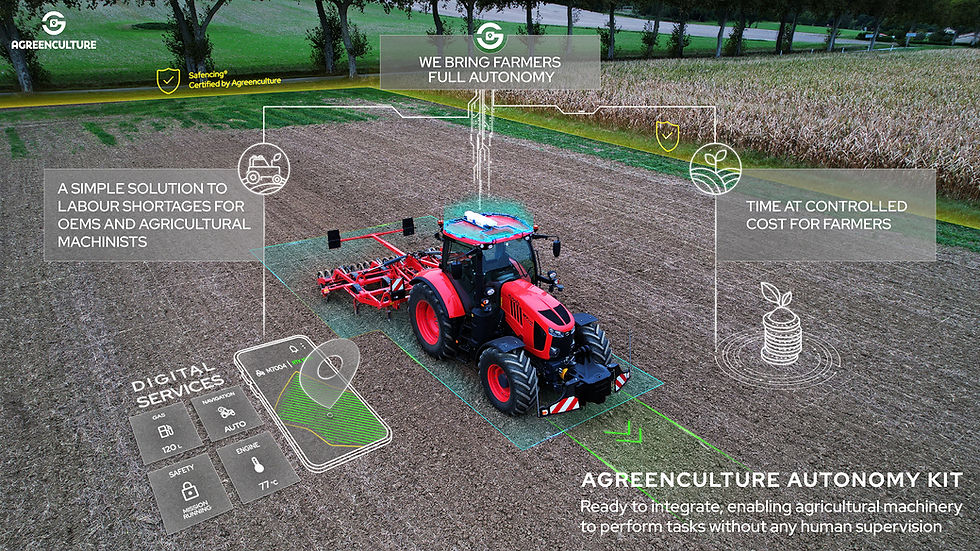
We have therefore evolved our model towards designing robotics kits that allow manufacturers to automate their own machines. We contribute our expertise in autonomy, functional safety, environmental awareness, and mission supervision
Therefore, we have implemented "challenges" where we build full-scale demonstrators on 30 to 50 hectares to test the models, in collaboration with farmers and manufacturers. This is how Kuhn's first robot using our solutions was tested in 2018, and Kubota's robot is scheduled for 2025. In total, we have delivered around one hundred control units for autonomous machines this year to all our customers in France, the Netherlands, Spain, Italy, and Germany.
Safety is a central issue. An autonomous machine must be able to position itself precisely, detect obstacles, monitor its environment, and operate agricultural tools safely. Artificial intelligence brings considerable value to understanding situations encountered in the field, but the goal remains to assist the farmer, not to replace them in all decisions.
Among the priority tasks for agricultural robotics, a balance must be struck between the most time-consuming and those easiest to make safe. The goal is therefore to be as versatile as possible, ensuring a high number of working hours and thus the tool's profitability: mechanical weeding and soil preparation, in particular. Furthermore, with effective data management and artificial intelligence systems, it becomes possible to detect certain diseases earlier, identify weeds, and optimize interventions. For tasks such as vine pruning or corn detasseling, safety must be the primary focus. Finally, there is a significant need for manual labor in orchard spraying, and these tasks should be prioritized for robotics."
Source : https://www.agridees.com/3-questions/christophe-aube-president-et-fondateur-dagreenculture/
About Agreenculture:
Agreenculture provides machine and tractor manufacturers with the ability to rapidly develop autonomous, intelligent, and secure solutions compliant with European regulations. Its AGC autonomy kit, ready for integration, leverages Safe-RTK® and Safencing® technologies to ensure safe autonomous operation without local supervision. These solutions enable farmers to save time, improve profitability, and reduce the environmental impact of agricultural operations.
More information at https://www.agreenculture.fr/en
Contact Presse: Hortense Serreau – Head of communications communication@agreenculture.fr