KAFE Challenge: A Pilot Project on Strip Cropping and Machine Autonomy
Updated: Sep 17
The Origin of the KAFE Challenge
Robotics must be able to transform our crop management and farming methods, to do better in less time, and thus reveal its full value. Christophe Aubé — CEO, Agreenculture
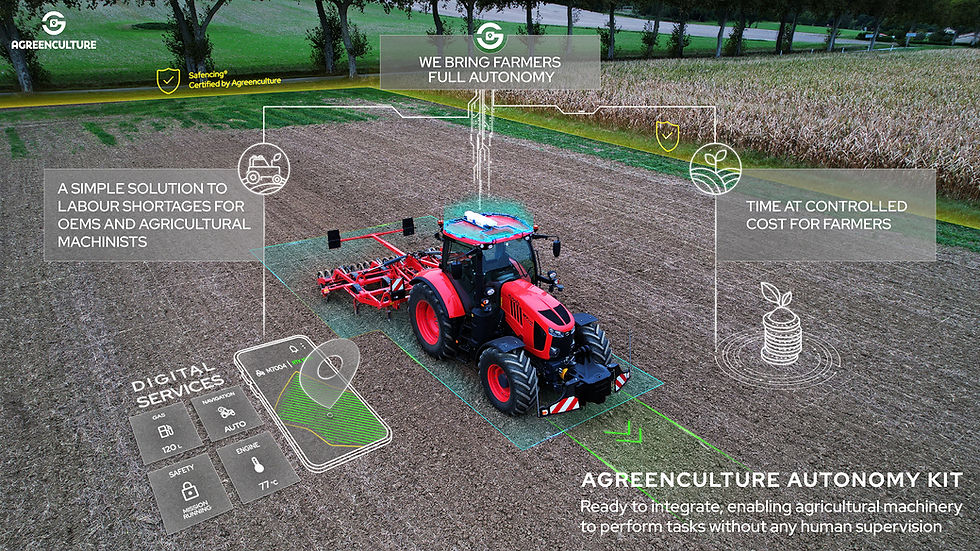
The KAFE Challenge proposes a solution based on fully robotized strip cropping. This method is executed with a standard tractor and standard implements, such as seed drills, sprayers, and fertilizer spreaders, all operated autonomously.
The goal is not to revolutionize the tools, but to revolutionize the way they are used.
Understanding Strip Cropping: Diversity, Boundaries, and Precision
Strip cropping involves growing various species in parallel strips on the same plot. Each strip is sown, cultivated, and harvested at different times, adhering to precise agronomic rules.
This technique has been utilized without robotics, particularly in the Netherlands, but remains marginal. The reason for this is clear: it increases the interfaces between crops. Each interface demands time, vigilance, and precision, leading to complexity. In agriculture, complexity translates directly into increased workload for the farmer.
Strip cropping maximizes the number of boundaries between crops. Each boundary imposes high requirements, especially regarding spraying. Even slight product drift can negatively impact adjacent crops. This necessitates a level of precision that only robotics can consistently and reliably achieve.
The project's equation is as follows: increased complexity in crop organization is accepted because it does not affect the farmer's schedule. Robotics absorbs this time, which is where the fundamental value of autonomy lies.
Technical Challenges to Overcome
Transitioning from vision to reality required addressing several concrete issues closely tied to field conditions and farm machinery.
Compatibility of Implements with Spatial Organization
The definition of strip cropping bands is directly influenced by the working widths of the implements used: seed drill, sprayer, fertilizer spreader. The width of the strips must be an exact multiple of the implement widths to avoid underperformance. For instance, using only a third of a seed drill's width would be economically unfeasible. This requirement became a significant challenge when the available implements were confirmed only at the last moment of the KAFE Challenge.
Irrigation and Economic Consistency
The plots involved were irrigated. Irrigating over 20 meters has a different economic logic compared to irrigating over 80 meters. The project had to integrate this constraint into the strip definition to maintain agronomic and economic coherence.
Precision Agriculture and Density Adjustment
Soil analyses provided seeding density recommendations by zone. The challenge was to adjust these densities in real time, considering that different implements (seed drill, row cultivator, mechanical tool) had to pass over the same location in sequence.
To address uncertainty about the implements, the solution adopted was to use the geographic coordinates of the crop rows as a fixed reference. Although this introduced slight sub-optimization, it preserved spatial consistency regardless of the available implements. This approach is similar to that used in the 2018 Centeol Challenge.
A Five-Partner Project: Governance as a Key Issue
The KAFE Challenge is not merely a unilateral technology project. It relies on an ecosystem of five partners whose alignment is essential for success.
| Partner | Role |
| --- | --- |
| The farmer | Responsible for implementing practices on the ground. |
| Soil knowledge, landowner | Provides insights into soil conditions and land management. |
| The seed supplier: RAGT | Involved in crop selection, seed choice, and sowing schedules. |
| Agreenculture | Focuses on machine and implement autonomy. |
| Kubota | Tractor manufacturer, providing essential machinery for the project. |
| Kverneland / Kubota | Machinery supplier, implement provider, ensuring compatibility and functionality. |
The agroecological approach only makes sense if all stakeholders are aligned on the final outcome and committed over multiple years. Implementing strip cropping for a single season offers limited benefits. The full advantages—such as long rotations, biodiversity preservation, nitrogen-trap crops, and resilience to climate variability and pests—only materialize over several years.
The project also raised questions about the relationship between partners. It shifted from a client/supplier logic to a genuine project partnership. Informal meetings throughout the season facilitated understanding among machinery and implement manufacturers about what autonomy truly means. This collaboration helped identify the development work needed to achieve ecological ambitions through robotics.
Our ambition is to build a true synergy with our partners, well beyond a conventional client/supplier relationship. Christophe Aubé — CEO, Agreenculture
Successes, Frustrations, and Lessons Learned
The project delivered valuable lessons, both in its achievements and in areas where it fell short.
What Worked
Partners fully grasped the value of strip cropping while also appreciating its complexity, enabling precise identification of the additional development work required.
A wide range of different implements were robotized and successfully deployed, demonstrating compatibility of conventional farm machinery with an autonomous approach.
Real-world use of the system, even at an accelerated level of complexity, produced a specification document grounded in field facts rather than assumptions.
Partners gained a genuine understanding of what autonomy truly means, far beyond passive auto-steering.
Challenges and Frustrations
A project limited to a single season. Agroecology, particularly strip cropping, must be measured over multiple years. Without a multi-year commitment, it is impossible to demonstrate benefits on biodiversity, long rotations, or climate resilience.
Significant wildlife damage. Wild boar caused considerable disruption to the plots, complicating thorough and reliable measurement of agronomic performance.
Late confirmation of implements. Uncertainty regarding available implements in advance introduced constraints in strip definition. This issue is fixable but highlights the importance of early-stage coordination.
Spring crops only. Combining winter and spring crops would have amplified positive effects on biodiversity—an identified area for improvement in future editions.
What's Next for the KAFE Challenge?
The ambition for the next iteration of the challenge is clearly stated: go further, broader, and longer.
Objectives for the Next Edition
Multiple machine types: Interoperability of robotic solutions will be a key factor.
Larger and more diverse plots to test at greater scale.
A multi-year commitment, a necessary condition for measuring biodiversity and resilience.
Demonstrate profitability from the first harvest year for the farmer.
Measure biodiversity using a rigorous scientific protocol: Several times per year, over multiple years, at various points across the plots.
The project is built on a strong conviction: biodiversity cannot be measured on paper once a year. It requires a rigorous technical and economic protocol, regular surveys (monthly, at different locations), and an observation period spanning multiple seasons. Only under these conditions will robotized strip cropping be able to demonstrate a dual return on investment: economic and environmental.
Our objective is a dual ROI: economic and environmental. Demonstrating profitability from the first harvest year, and over multiple years, the preservation or restoration of biodiversity. Christophe Aubé — CEO of Agreenculture
The KAFE Challenge has proven that such a vision is technically achievable with standard farm machinery. What remains is to demonstrate it at scale, over time, and with multiple partners collaborating effectively.