Autonomous Tractors: Between Regulatory Framework and Technical Challenges

The agricultural robotics landscape is evolving rapidly, but one central question remains for manufacturers and operators alike: how do you integrate autonomy into a legal framework originally designed for humans?
Between the Tractor Regulation and the Machinery Directive, the boundary is sometimes thin, and understanding these nuances is crucial to ensuring the safety and compliance of tomorrow's solutions.
Distinguishing Tractor from Machine: A Question of Approval
To properly understand field robotics, one must first distinguish between the two major legal categories governing agricultural equipment. This classification is not merely a matter of semantics, it determines the applicable safety rules and approval processes.
On one hand, the Agricultural Tractor, as defined by Regulation (EU) No 167/2013, is a motor vehicle (wheeled or tracked) with at least two axles and a top speed exceeding 6 km/h, whose primary function is traction. Due to the risks associated with road traffic, it is subject to third-party type approval.
On the other hand, the Machine, governed by Directive 2006/42/EC (and soon by Regulation 2023/1230, which will come into force on 20 January 2027), is an assembly equipped with a drive system with at least one moving part for a defined application. Unlike the tractor, machinery falls under self-certification with CE marking: the manufacturer declares conformity themselves.
Autosteering vs. Autonomy: Responsibility at the Heart of the Debate
Automated driving assistance and true autonomy are often conflated. Yet the regulatory framework draws a clear distinction based on who bears responsibility for safety.
Autosteering is a driving assistance feature. The operator is present in the vehicle, monitors operation, and remains responsible for safety (emergency braking, obstacle avoidance).
Autonomy, as defined in the new Machinery Regulation (EU) 2023/1230, is characterised by the absence of continuous human interaction. Here, the control system must incorporate its own safety functions to protect people and the environment, without relying on an operator.
The Specific Challenge of the Autonomous Tractor
The term "autonomous tractor" represents a genuine regulatory challenge today. The Tractor Mother Regulation (TMR 167/2013) was drafted at a time when autonomy was not yet an industrial concern, and therefore does not provide for the tests required to approve a driverless vehicle.
To navigate this situation, innovators can rely on Article 35 of the TMR. This provision allows for provisional national-level approval of innovative technologies, provided a level of safety at least equivalent to existing standards can be demonstrated. It is an essential gateway for testing and validating safety protocols under real-world conditions.
The Retrofit Challenge
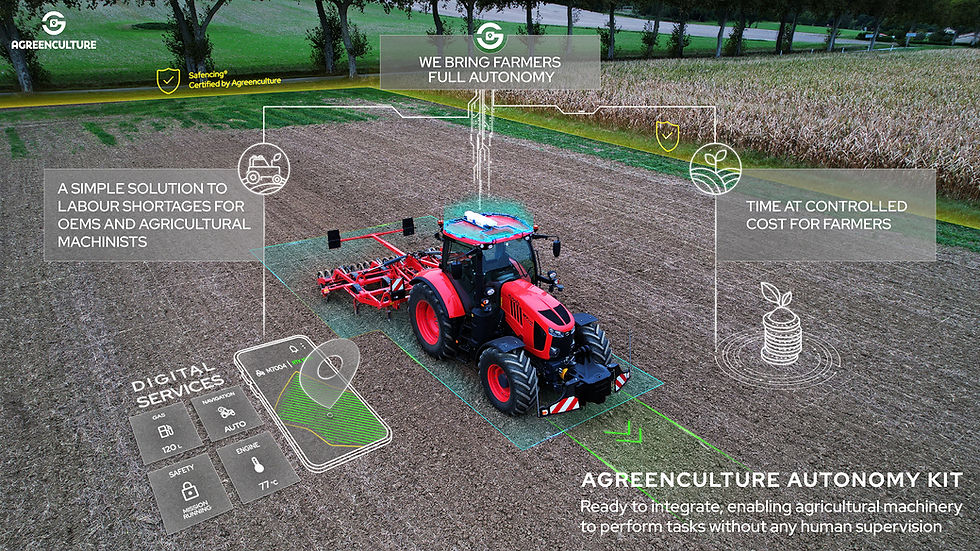
Installing an "autonomy kit" on a standard tractor, commonly known as retrofitting, is not a trivial undertaking. By modifying steering or braking functions, the installer may alter the nature of the machine and cause it to lose its original type approval. The entity installing the autonomy kit thereby assumes the responsibilities of the manufacturer and must ensure a new conformity assessment.
An interesting alternative is to leverage the intelligence of the tractor-implement combination. Through the ISOBUS protocol and its TIM (Tractor Implement Management) functionality, communication between the two machines has become bidirectional: the implement controls certain tractor functions (speed, hydraulics, even steering ) to optimise its own operation.
Safety then becomes a shared responsibility between both pieces of equipment, but it is the implement that must incorporate the hazards induced by the tractor it controls into its own risk assessment. The key regulatory advantage is this: the tractor retains its original type approval under Regulation (EU) No 167/2013, while the implement alone bears the conformity obligations under the Machinery Directive 2006/42/EC, in the category of interchangeable towed equipment, defined as any device designed to be towed by a tractor that incorporates tools or functions that modify or add to the tractor's behaviour.
Safety by Design
Integrating autonomy requires moving from human-managed safety to risk management by design. Whether preventing the accidental activation of autonomous mode on public roads or managing interactions with bystanders, every scenario must be technically anticipated.
At Agreenculture, we closely monitor these developments to ensure that technological innovation always goes hand in hand with regulatory rigor. We firmly believe that compliance should not be seen as a barrier, but as the essential foundation for the widespread adoption of robotics.
The challenge is no longer simply about making intelligent agricultural machines, but about building an environment of trust, one that allows robotics players and machine users alike to focus on agronomic performance and the profitability of their operations. By integrating these constraints from the design stage onwards, we turn the regulatory challenge into a guarantee of reliability, for a more precise, safer, and resolutely future-oriented agriculture.
Sources: